
Free BaZi Calculator — Four Pillars of Destiny Chart
Calculate your Four Pillars of Destiny, Day Master, Ten Gods and luck pillars, with true solar time and historical timezone correction. Free chart calculations run in your browser.
Why HeavenStem
- True solar time shown step-by-step
- Historical daylight-saving handled (incl. China 1986–91)
- Hidden stems & Ten Gods included
- Free chart calculations stay in your browser
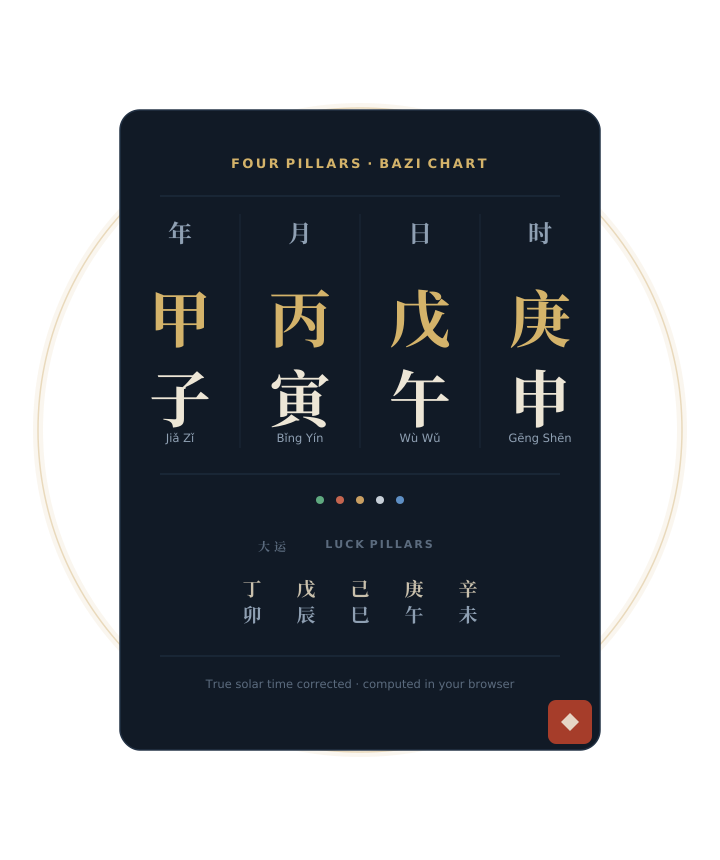
- True solar time shown step-by-step
- Historical daylight-saving handled (incl. China 1986–91)
- Hidden stems & Ten Gods included
- Free chart calculations stay in your browser
Your four pillars will appear here.
What is a BaZi chart?
BaZi — literally "eight characters" — is the common name for the Four Pillars of Destiny, a system developed over roughly a thousand years of Chinese calendar science. Your birth moment is expressed as four pairs of characters: one for the year, one for the month, one for the day, and one for the hour. Each pair combines a Heavenly Stem with an Earthly Branch, giving the eight characters the system is named for.
The stems and branches are not mystical inventions — they are the counting cycles of the traditional Chinese calendar, the same cycles that name years like 甲辰 (Jia Chen, 2024). Every stem and branch carries a Yin or Yang polarity and one of the Five Elements (Wood, Fire, Earth, Metal, Water), so the eight characters together form a compact map of the energies present at your birth.
Birth time matters because the hour pillar is one quarter of the chart. Two people born on the same day four hours apart share six of their eight characters but differ in the final pillar — and the hour pillar governs the chart's readings about inner life, children, and later years. This is why an accurate clock time, corrected to true solar time, changes real charts.
How this BaZi calculator works
- Enter your birth details. Gregorian or lunar date (with leap-month support), clock time to the minute — or the unknown-time mode — and your birth city, chosen from a global list so we get exact coordinates.
- Resolve the timezone for that date. We look up the city's IANA timezone and apply the offset that was actually in force on your birth date, including historical daylight-saving periods such as China's 1986–1991 experiment.
- Correct to true solar time. Your longitude shifts the clock by four minutes per degree from the timezone's central meridian, and the equation of time adds the seasonal difference between clock noon and solar noon. Both corrections are shown step by step in your results.
- Plot the pillars against the solar terms. Year and month pillars change at the exact minute of each solar term (节气) — not at midnight, and not on the first of the month — using astronomical ephemeris data. The full method is documented on our methodology page.
Calculate your Day Master, Ten Gods and luck pillars
Find your BaZi Day Master
After plotting, look for the day pillar labeled Day Master 日主. Its top character is your Day Master: one of ten Heavenly Stems, combining an element with yin or yang. For example, Jia (甲) is Yang Wood and Yi (乙) is Yin Wood. The BaZi Day Master guide lists all ten and explains how to read them in the context of a full chart.
Read the Ten Gods chart
The Ten Gods results table labels the other stems relative to your Day Master. Turn on hidden stems to include the stems inside each Earthly Branch. These traditional relationship roles are explained in the Ten Gods meanings and reference table.
Find your current luck pillar
The luck-pillar timeline shows successive ten-year cycles and their calculated starting ages. Your birth moment, the adjacent solar term, gender and year-stem polarity determine the sequence. The Da Yun luck-pillars guide explains the start-age rule and how to distinguish a decade's themes from a prediction of specific events.
True solar time calculation for your birth city
BaZi hours are two-hour blocks tied to the sun's position: the Zi hour centers on solar midnight, the Wu hour on solar noon. Civil clocks, however, keep zone time — a single offset stretched across thousands of kilometers. For a worked example, 14:32 on May 17, 2000 in Shanghai (121.47°E) becomes about 14:41 true solar time. The city is 1.47° east of the UTC+8 meridian at 120°E, adding about 5 minutes 53 seconds; that date's equation of time adds about 3 minutes 41 seconds. No daylight saving applied there on that date. Near a two-hour boundary, a correction like this can change the hour pillar.
Historical timezone changes matter just as much. China observed daylight saving from 1986 to 1991, so a summer birth in those years was registered on a clock running one hour ahead of standard time; the United States extended its DST period in 2007; entire countries have shifted their standard meridians over the last century. This calculator resolves the offset that was genuinely in force on your birth date rather than today's offset. Read more in our true solar time glossary entry.
How to read your four pillars
The year pillar describes your roots: ancestry, early environment, and the generation you arrived in. It is the broadest brush — shared by everyone born in the same year — and frames how the world first received you.
The month pillar marks the season of your birth and is traditionally read as your growth climate: career style, public standing, and the conditions you thrive in. Because months begin at the solar terms rather than calendar months, this pillar carries the chart's strongest seasonal signal.
The day pillar is the heart of the chart. Its stem is your Day Master — the element and polarity every other character is measured against — and its branch speaks to close partnership. When a reading says "you are Yang Water," it is describing your Day Master.
The hour pillar covers your inner life: private ambitions, creative output, children, and the later decades. The relationships between all eight characters and the Day Master are named by the Ten Gods, and the ten-year chapters of life are mapped by the luck pillars — together they turn eight characters into a readable story.
Frequently asked questions
5,000–7,000 words · 16 chapters · delivered in minutes
A comparable reading from a human practitioner runs $155–2,500.
Secure checkout by Lemon Squeezy · VAT handled · 7-day accuracy refund · PDF + web access